
An army formed of good officers moves like clock-work.
George Washington
Although the precise origin of “like clockwork” is unclear, references to clock-work can be found in literature throughout the 17th century:
- Samuel Pepys (1661) marvels at automata and clockwork displays, frequently using the word “clock-work” in his Diary.
- John Donne (c. 1610) compares the human body to a clock in A Funeral Elegy.
- Thomas Lodge (1592, read into the 16th c.) uses “as a clock” similes, providing evidence that clock metaphor is in active use.
- Robert Hooke (mid- to late-1600s) leans on clock analogies to explain mechanism, with “nature as a clock”.
But it’s deep into the 18th century when the earliest citation of idiomatic usage appears – of something running “like clockwork”. The Oxford English Dictionary referred to the phrase “everything moves like clockwork” in 1775. However, no examples of such usage can be found in prior literature, leading us to assume that it was merely a colloquial expression at the time.
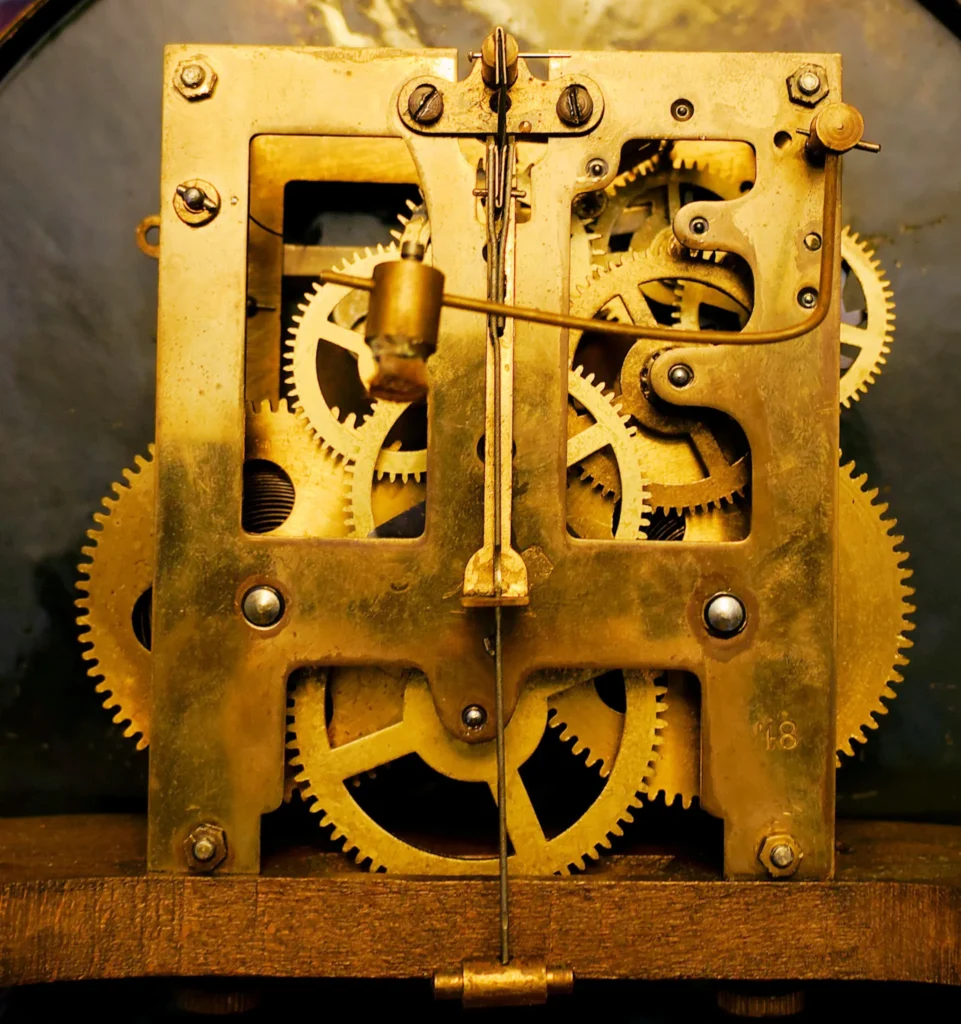
And so it fell to George Washington, a year later, to provide us with the earliest known written instance of “like clock-work” in correspondence with the President of the Continental Congress, John Hancock, during the Revolutionary War.
Washington had retreated north from New York City to Harlem Heights after the American defeat to the British at the Battle of Long Island (in August 1776), and the fall of Manhattan (in mid-September). His letter was written on September 4th, 1776, while he was in the process of reorganizing and reinforcing the Continental Army.
Sir,

Since I had the honor of addressing you last, nothing material has occurred. The enemy remain in their present position and continue to strengthen their lines. From some movements yesterday and the day before, and the advices received from deserters, it would seem as if they were preparing to attack us, or to make a diversion elsewhere.

An army formed of good officers moves like clock-work; but there is no situation upon earth less enviable, nor more distressing, than that person’s who is at the head of troops, who are regardless of order and discipline, and unprovided with almost every necessary. There is such a mixture of the brigadier’s authority with that of the states, that it is next to impossible to conduct the business of the army.

I am wearied almost to death with the retrograde motion of things, and I solemnly declare that no man, I believe, ever encountered greater difficulties or so great a variety of embarrassment as I have done, and that too, with so little success to encourage perseverance.

The appointment of general officers, as recommended by Congress, is exceedingly necessary; our business cannot be conducted without them, as it is impossible for the Commander in Chief to attend to every detail in person.

I have the honor to be, etc.,

G. Washington
So George Washington was among the earliest adopters of the idiom “like clockwork”, and he may even have been the first to coin it, given his meticulous, technical, and disciplined mind. That gives us a uniquely American origin for a phrase that many assume was born in England!